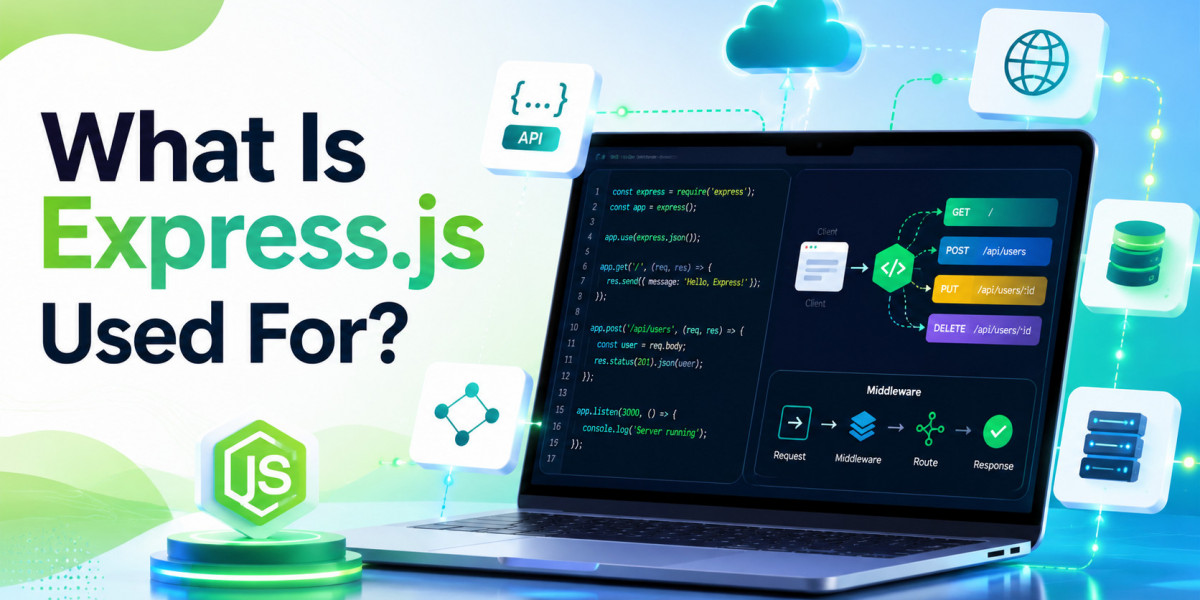

Let's dig in deeper
Express.js Is Used for Building APIs
One of the most common uses of Express.js is API development.
An API allows two systems to communicate. For example, your frontend may ask the backend, “Can you send me this user's profile?” The backend receives that request, gets the data, and sends it back in a format like JSON.
Express is widely used for creating REST APIs because it makes routing, request handling, and response management simple.
In addition to this, according to the official site of Express, building APIs is one of its core strengths.
For example, an Express API can be used in:
- E-commerce websites
- Banking dashboards
- Learning platforms
- Food delivery apps
- Booking systems
- Mobile applications
- Admin panels
- SaaS products
This is why many beginners start with Node.js Foundations first and then move into Express.js Foundations . Node.js teaches how JavaScript works on the server, while Express.js teaches how to structure real backend applications.
Express.js Is Used for Routing
Routing is one of the biggest reasons developers use Express.
A route tells your server what to do when a user visits a specific URL or sends a specific request.
For example:
- When a user visits /login, show or process login details.
- When a user visits /products, return product data.
- When a user visits /orders, show order history.
Without a framework, managing many routes can become messy. Express gives developers a neat way to define and organize these routes.
This is especially helpful when a project grows. A small app may start with five routes. But a real-world product may have hundreds of routes for users, payments, reports, dashboards, notifications, and admin controls.
Express helps keep that backend logic readable.
Express.js Is Used for Middleware
Middleware is one of the most powerful concepts in Express.js.
Think of middleware as a checkpoint between the request and the final response.
For example, before allowing a user to open a dashboard, the server may need to check:
- Is the user logged in?
- Is the token valid?
- Does the user have permission?
- Should this request be logged?
- Is the uploaded file safe?
Middleware handles these kinds of tasks.
This makes Express useful for authentication, security checks, error handling, request validation, logging, and file uploads.
In real projects, middleware keeps the application organized because every task does not have to be written inside every route. Instead, common logic can be reused across many routes.
Express.js Is Used for Web Applications
Express is not only for APIs. It can also be used to build full web applications.
For example, a developer can use Express to serve HTML pages, handle form submissions, manage sessions, and connect with template engines. This is useful for blogs, dashboards, internal tools, admin portals, and business websites.
Currently, many contemporary applications use React, Angular, or Vue for the front end and Express for the back end.
In such cases, Express is responsible for handling data, authentication, and communication with databases.
This combination is common in full-stack JavaScript development because both frontend and backend can use JavaScript.
Express.js Is Used with Databases
Express does not store data by itself. It is not a database.
But Express is often used to connect your application with databases such as MongoDB, PostgreSQL, MySQL, or Redis.
For example, when a user signs up, Express can receive the signup details, validate them, encrypt the password, and save the user information in a database.
When the user logs in later, Express can check the database and return the correct response.
This is why Express is often seen in full-stack development courses and projects. A good Node.js course usually teaches not just routes, but also how Express connects with databases, handles errors, protects user data, and structures backend code.
Express.js Is Used for Authentication and Authorization
Many applications need login systems.
Express can help build authentication features such as:
- User signup
- User login
- Password reset
- JWT-based authentication
- Session-based login
- Role-based access
- Protected routes
For example, an admin should be able to access the admin dashboard, but a normal user should not. Express can help manage this logic through routes and middleware.
This makes it useful for real business applications where users have different permissions.
Express.js Is Used for Backend Business Logic
A backend does more than send and receive data.
It also deals with business rules.
For example:
- Should this discount apply?
- Can this user cancel the order?
- Is this payment valid?
- Has the subscription expired?
- Should this report be visible to this role?
Express provides developers a way to express this logic explicitly.
This is one reason Express is popular among beginners and professionals. It does not force too many rules, but it gives enough structure to build useful applications.
MDN describes Express as a popular Node.js web framework and notes that it provides mechanisms for handling web application needs.
Express.js Is Used for Microservices
Express is also used to build small backend services known as microservices.
A company may have separate services for users, payments, notifications, orders, reports, and analytics. Each service can expose its own API.
Because Express is lightweight and flexible, it can be a good choice for building these small services.
For example, one Express service may only handle payment verification. Another may only handle email notifications. This makes systems easier to scale and maintain when designed properly.
So, Should You Learn Express.js?
Yes—especially if you want to build APIs, full-stack JavaScript apps, or backend services. Start with the fundamentals, practice with small projects, and gradually build real applications. A well-structured Node.js course that includes Express.js Foundations can make that journey smoother without overwhelming you.
Because in the end, Express.js is not just about writing backend code.
It's about understanding how modern applications talk, respond, protect data, and serve users.