
In today’s advanced manufacturing environment, the combination of 3D printing software and high-precision 3D laser printers is transforming how industries design, prototype, and mass-produce components. Among the most powerful technologies, SLA, SLS, and SLM stand out for their accuracy, material performance, and application versatility. For companies seeking faster production, stronger mechanical properties, and digital manufacturing flexibility, understanding these three processes is essential.
SLA: High-Resolution Laser Curing for Smooth Surfaces
SLA (Stereolithography Apparatus) remains one of the most popular resin-based printing technologies used with modern 3D laser printers. With advanced 3D printing software, SLA systems use a UV laser to selectively cure photopolymer resin layer by layer.
Key Advantages of SLA
Extremely high dimensional accuracy
Ultra-smooth surface finish suitable for visual prototypes
Excellent detail reproduction for complex shapes
Industries such as dental, jewelry, medical devices, and electronics rely on SLA because it produces fine, detailed parts with minimal post-processing.
SLS: Powder-Based Laser Sintering for Durable Functional Parts
SLS (Selective Laser Sintering) takes 3D printing to the next level by using a high-power laser to fuse nylon or polymer powders. Compared with SLA, SLS delivers stronger mechanical properties, making it ideal for end-use functional components.
Key Advantages of SLS
No support structures needed
High material strength and durability
Fast production of multiple parts in one build
With powerful 3D printing software controlling scanning paths, powder distribution, and sintering parameters, SLS is widely used in automotive, aerospace, consumer products, and industrial manufacturing.
SLM: Metal Additive Manufacturing for Industrial-Grade Strength
For applications demanding metal-strength performance, SLM (Selective Laser Melting) is the leading choice. Using a high-energy fiber laser, an SLM 3D laser printer fully melts fine metal powder to form dense, robust metal components.
Key Advantages of SLM
Produces near-net-shape metal parts
Excellent mechanical strength, comparable to forged metals
Ideal for complex geometries impossible with machining
SLM is widely applied in aerospace, medical implants, robotics, and high-end industrial machinery.
The Core Role of 3D Printing Software
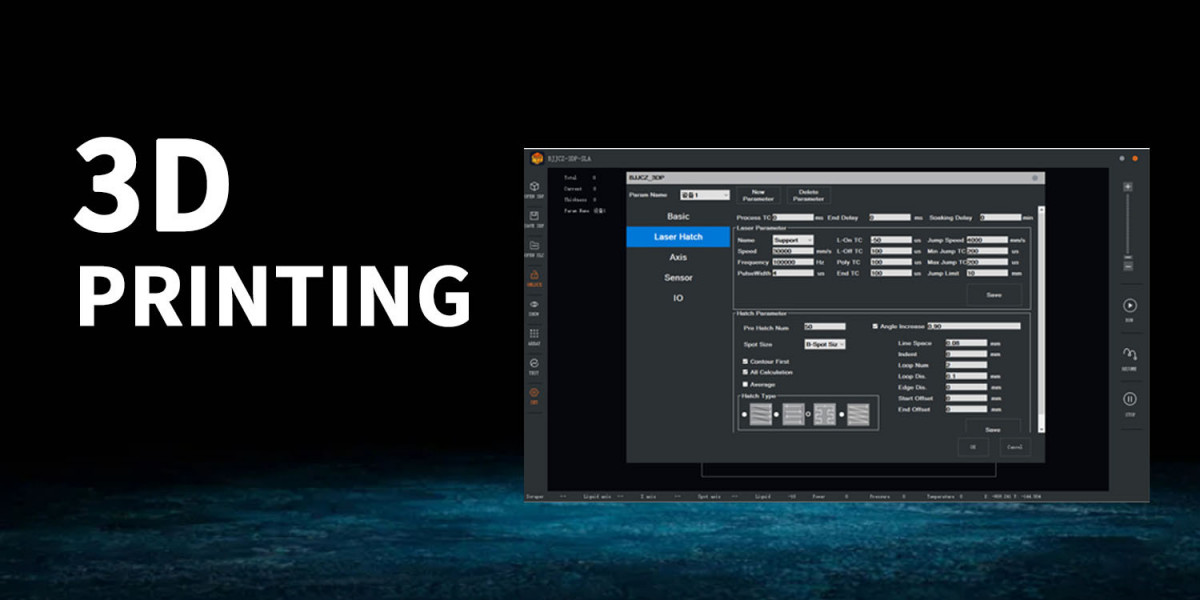
Whether for SLA, SLS, or SLM, 3D printing software is the backbone of successful additive manufacturing. From slicing and support generation to laser path optimization and thermal compensation, powerful software directly influences printing quality, speed, and reliability.
Advanced 3D printing software provides:
Optimized laser scanning strategies
Precise parameter control for resin, polymer, or metal powder
AI-enabled part orientation and material usage optimization
Real-time monitoring for industrial production
This seamless combination of software intelligence and hardware capability is what makes modern 3D laser printers so effective for both prototyping and mass production.
Conclusion
As industries shift toward digital manufacturing, the integration of advanced 3D printing software with SLA, SLS, and SLM 3D laser printers is accelerating innovation. From detailed resin models to robust polymer parts and fully dense metal components, these technologies empower companies to reduce costs, increase flexibility, and achieve engineering-grade performance.
If you are searching for cutting-edge 3D printing solutions tailored to industrial applications, SLA, SLS, and SLM are the pillars of future manufacturing.